
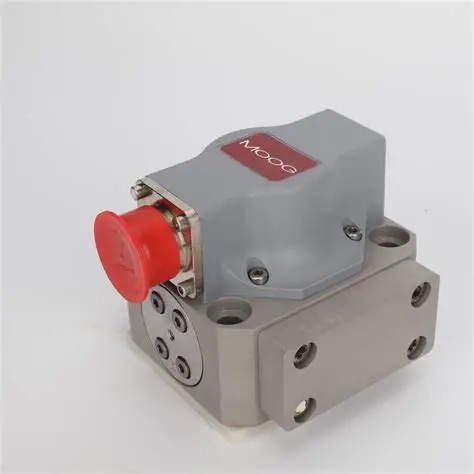

MOOG G761-3033B electro-hydraulic servo valve
product description
MOOG G761-3033B is a high-performance two-stage electro-hydraulic servo valve produced by MOOG Corporation in the United States. This equipment plays a crucial role in the fields of industrial automation and hydraulic control, and is widely used in scenarios such as power plant EH systems, metallurgical rolling, engineering machinery, and aerospace that require extremely high dynamic response and control accuracy.
1. Core functions and working principles
G761-3033B adopts an advanced two-stage hydraulic amplification structure, which precisely modulates the flow and pressure of the hydraulic system through electrical signals:
Pilot stage (micro control): A symmetrical dual nozzle baffle valve driven by a dry torque motor. When an analog electrical signal is input, the torque motor generates electromagnetic torque to deflect the baffle, change the nozzle back pressure, and form a primary hydraulic signal.
Power stage (strong output): The hydraulic signal output from the pilot stage drives the movement of the four-way spool valve. The displacement of the valve core will open the channel between the oil supply port (P) and the working oil port (A/B), achieving precise control of the actuator.
Double closed loop feedback: In addition to the mechanical position feedback provided by the cantilever spring rod to eliminate empty travel, the valve can also be equipped with an electrical position feedback module (displacement sensor) to form an electrical closed loop, with hysteresis below 0.5% and resolution better than 0.1%.
2. Core technical features
Excellent dynamic performance: With a bandwidth of over 100Hz and a step response time of less than 10ms, it can perfectly handle high-frequency control and fast load adjustment scenarios.
High reliability and power-off protection: The design is sturdy, with an average time between failures (MTBF) of over 100000 hours. Equipped with power-off protection function, the valve core can automatically reset to a safe position in case of unexpected power outage, avoiding equipment damage.
Strong anti pollution ability: Equipped with a replaceable disc-shaped oil filter (filtration accuracy ≤ 5 μ m) and a high-pressure filter system, it can effectively intercept small particles and extend its service life.
Modular Expansion: Supports the installation of fieldbus communication interfaces (such as+ZBE03 module) to flexibly adapt to various digital control system requirements.
3. Key technical parameters
Working pressure: up to 315 bar (oil ports P/X/A/B).
Rated flow rate: 4~63 L/min (depending on the system pressure drop, usually calibrated at a rated pressure drop of 7MPa).
Electrical specifications: Single coil resistance of 80 Ω, rated current of 40mA, low-power design.
Environmental adaptability: Wide working temperature range (-29 ℃ to+135 ℃), using fluororubber seals, compatible with petroleum based hydraulic oil (viscosity 60-450 ℃) SUS@38 ℃).
Installation standard: Compliant with ISO 4401 standard, T-shaped oil circuit layout.
4. Typical application scenarios
Energy and electricity: As the core component of the turbine speed control system (EH system), speed closed-loop control is achieved by adjusting the opening of the steam valve; Also used for wind power pitch control.
Metallurgical equipment: used in the hydraulic pressing system of the rolling mill to adjust the gap between the rolling rolls in real time to ensure minimal thickness deviation (<± 1 μ m) of the plate and strip, and improve product yield.
Construction Machinery: Used for excavator main valve control and crane load sensitive control, achieving continuous regulation of flow and pressure, reducing system heat generation and fuel consumption.
Aerospace: With lightweight design (approximately 1.1kg~2.1kg) and extremely high reliability, it meets the strict requirements of precise closed-loop control of aircraft rudder deflection angle.
5. Maintenance and safety precautions
Cleanliness requirement: Servo valves are extremely sensitive to oil cleanliness (recommended NAS grade ≤ 8). More than 92% of early failures are caused by particle contamination due to filter failure. It is recommended to replace hydraulic oil and precision filters regularly every six months.
Online replacement risk: When conducting online replacement under critical working conditions such as power plants, a work permit must be obtained and protection measures must be taken. If the oil supply cut-off valve or OPC check valve is not tightly closed, it may cause a large amount of oil leakage or even unplanned shutdown during disassembly. It is necessary to prepare sufficient EH oil and closely monitor the system pressure.
Flushing specification: After the system is installed, the oil circuit must be cleaned (flushed for 24-36 hours) before installing the servo valve to prevent impurities from clogging the valve core.



Reviews
There are no reviews yet.